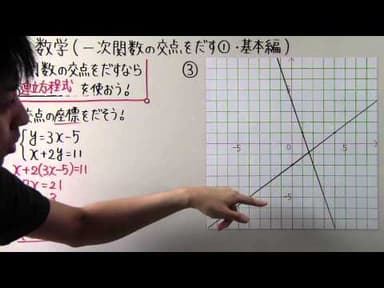
Finding the Intersection Point of Two Linear Functions: Basic Edition
とある男が授業をしてみたAI summary of “Finding the Intersection Point of Two Linear Functions: Basic Edition” by とある男が授業をしてみた, generated by Sumvid.
Title
Finding the Intersection Point of Two Linear Functions: Basic Edition
One-Sentence Summary
This video teaches middle school second-year students how to find the coordinates of the intersection point where two linear functions meet by using simultaneous equations.
Key Takeaways
- [0:02] The video covers how to find intersection points of two lines, which is an essential skill for word problems and mathematical problem-solving.
- [1:36] To find the intersection point of any two functions (whether linear or quadratic), always use simultaneous equations—this method works universally across different function types.
- [2:39] When both lines are already expressed as equations, simply set up and solve a system of simultaneous equations using either the substitution or elimination method to find the x and y coordinates.
- [3:46] The final answer must be written in coordinate notation (e.g., "3, 4") rather than just listing the x and y values separately—this is the proper format for stating a point's coordinates.
- [4:16] When intersection points fall on non-integer or unclear locations on a graph, you must first determine the equations of both lines by finding their slopes and y-intercepts, then solve the simultaneous equations.
- [7:27] This is a fundamental technique that will definitely appear on tests, so students should master the process of deriving line equations and solving simultaneous equations together.